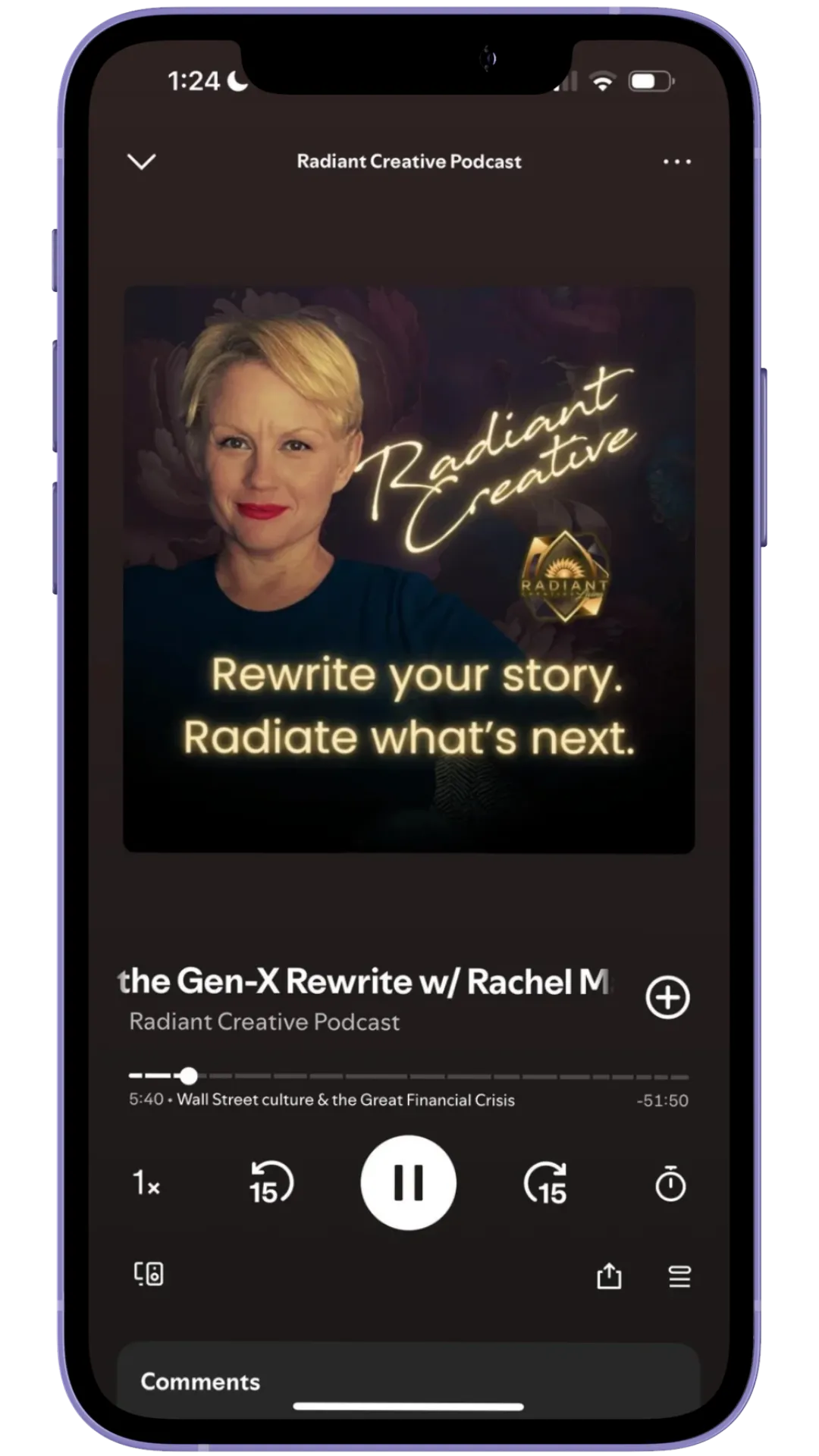


From Wine-O’Clock to Author: Gray-Area Drinking & the Gen-X Rewrite w/ Rachel Mack Martin [Full Transcript]
Radiant Creative Podcast, Episode 1 FULL TRANSCRIPT: Featuring Rachel Mack Martin
Buy Rachel's book on Amazon: https://amzn.to/4pcMXdJ
Explore the full transcript of episode one of the Radiant Creative Podcast, featuring Rachel Mack Martin. Discover raw stories and actionable strategies for Gen X women, high-functioning habits, and midlife reinvention.
Episode Chapters:
- 00:00 “Am I drinking too much?” — the real question
- 00:28 Show intro: The Radiant Rewrite (Release → Regulate → Rebuild → Rewrite → Radiate)
- 01:20 Meet Rachel: finance, high achiever, wine-o’clock begins
- 04:17 Wall Street culture & the Great Financial Crisis
- 10:36 Convincers vs. rock bottom
- 14:33 Sober September: the first 30 days
- 27:15 The “boots & firepit” story (mortifying convincer)
- 28:40 “Why am I not enough?”—marriage & truth
- 32:27 Sleep, anxiety & REM (why alcohol keeps you wired)
- 40:12 From sobriety to authorship
- 43:58 Vulnerability at work, compliance & stigma
- 49:18 Tapering, plans & practical tips
- 50:09 Dating yourself (rediscovering desire)
- 55:24 Where to find Rachel + book
- 56:27 Outro: keep rewriting your story
Full Episode Transcript
Buy Rachel's book on Amazon: https://amzn.to/4pcMXdJ
Rachel Mack Martin (00:00)
you start Googling, am I drinking too much? Am I an alcoholic? You have a problem. And rather than sitting there diagnosing, is it a bad enough problem?
you just should recognize that it is a problem. And once you start addressing the problem, everything
Megan (00:28)
Your midlife crisis? It's a rewrite. I'm Megan Brown-Martinez, creative professional, recovering perfectionist, and fellow traveler through the messy, messy middle. Here we follow the radiant rewrite protocol. Five steps to moving forward in midlife. Release what's heavy, regulate what's raw, rebuild what's fallen apart, rewrite what no longer fits, and radiate.
What's next? From nervous system healing to creative renaissance, these real stories of midlife rewrites are where breakdowns become breakthroughs and your second act comes to life. Welcome to the Radiant Creative Podcast. You're in the director's chair. So let's begin your rewrite.
Megan (01:20)
Today's conversation is for every high achiever who looks like they've got it all together on paper. The career, relationships, the image, but quietly suspects that something isn't working anymore. My guest, Rachel Mack Martin is the author of Functional.
A high performer's guide to achieving freedom from alcohol. Her story begins inside the pressure cooker of corporate finance, where late night client drinks and constant performance were part of the job. And it unfolds into a powerful journey of truth, recovery, and reinvention.
Welcome, Rachel. I am so glad that you're here.
Rachel Mack Martin (02:02)
Thank you, Megan. I appreciate you having me.
Megan (02:04)
you were checking all of the boxes and that really resonated with me. You had said, I am.
getting up and going to work every day, I'm exercising at 5 a.m., I'm feeding my dogs, my house looks beautiful, everything is perfect and clean, my husband is fed, And that brings me to my midlife concept of masking, those labels that have been put on top of us.
throughout our lives, so can you tell me about your early career and your early life and where maybe what some of your masks may have been
Rachel Mack Martin (02:37)
would say that I was always a high performer. I did well with school. I attended college early. And so on a very surface level, I felt like I knew how to perform. I had more...
somewhat traditional values. I grew up in the Midwest in Minnesota. I was raised Catholic. going to church and, you know, I did the things like went to college, got a got a good job in financial services, worked my way up through the corporate ladder, I got married. we did the things like
I bought a house. I went back to school for my MBA. But the way that I was handling stress was really by drinking. And so I would perform throughout the day. wake up, I work out, I go to work. And then I come home and five o'clock was like wine o'clock. And what really started my habit
is around 2007, 2008, I had very serious work stress and I came home and started pouring a glass of wine, ⁓ which seems really, really normal. And pretty much it turned into this habit where every night I came home, poured myself a glass of wine.
Megan (03:52)
Mm-hmm.
Mm-hmm.
Rachel Mack Martin (04:03)
and then one glass became two glasses became three glasses became more and it really became like my crutch.
Megan (04:10)
Right.
2007, 2008, that tells me that was maybe the great financial crisis.
Rachel Mack Martin (04:17)
Yeah, absolutely. And I was working in financial services at the time. I was a bond trader. I was working in an environment that was, know, trading is always seen as a very high stress job. And it was. very few females in fixed income trading.
Megan (04:22)
Wow.
Mm-hmm.
Rachel Mack Martin (04:35)
I definitely felt different than like a lot of my coworkers just because I was a female.
Megan (04:42)
Mm-hmm. I was listening to the Mel Robbins podcast the other day and she had a gentleman on who talked about the concept of collective illusion. it's the idea that we do something because we think everyone else is doing it because they want to be doing it too.
But then it turns out that they're all doing it because they think that everyone else wants to be doing it too. I'd love to hear about your experience as a young woman in business, as a woman in such a male dominated field and your process of sort of going up the ranks of that very competitive ladder.
Rachel Mack Martin (04:59)
Thank
Sure.
Megan (05:18)
and where drinking might have slid in through either interest in fitting in or that sort of sense of collective illusion. I'd like your experiences as well as what you think about the culture of that kind of community in general.
Rachel Mack Martin (05:34)
I definitely view drinking as like something you do professionally. And I talked about it in my book, you know, I would, I think that's how people network.
I could think of a couple of my jobs who that, you I knew someone and they're like, you'd be, you'd be great in this role. We'll refer Rachel. And you know, they were someone like I met at happy hour or, you know, professionally. And it was just kind of something you did. I think there's a lot of occupations where that's pretty common.
especially within financial services and, would I have had a problem if I was in a different occupation? Possibly. But I definitely, it was very socially acceptable, I think. And especially for me too, I had this very funny attitude where
Megan (06:22)
Yes.
Rachel Mack Martin (06:28)
Like I kind of viewed beer as maybe like a working class male drink. ⁓ But wine, wine was like what sophisticated young professional women drank. And so that was really my drink of choice.
Megan (06:35)
Mm-hmm.
Yeah.
Yes, I can remember it was very, very exciting to get to go to beautiful restaurants and be served at gorgeous tables. And may I present you with a bottle of wine, madam? my, yes, you may. And beginning to learn about these things. And it does feel also.
glamorous and elegant and quite so mature and grown up. There's definitely an allure to it.
Did it help to smooth over any insecurities you might've had as a young woman in a very difficult professional field?
Rachel Mack Martin (07:18)
Yeah, I think so. I definitely felt more relaxed. I kind of felt like, okay, you go to different business dinners and you share a bottle of wine that's very custom, that's very common. And that's when the industry trade conversations kind of happen.
Megan (07:41)
But you never would have gotten that complete inside information if you weren't sitting right there for several hours, just socializing, just being together and just drinking.
Rachel Mack Martin (07:51)
Yeah, perhaps. Now I probably think differently, but at the time, that's what I thought.
Megan (07:59)
And how so now would it feel, does that feel different? Cause that's interesting that from a different perspective that maybe there were not, maybe the opportunities wouldn't have been lost without it.
Rachel Mack Martin (08:02)
BANG!
Well,
yes, so my perception used to be really everyone drank. And now that especially like I've been alcohol free for a long time, what I find especially true is that a lot of high performers or very powerful people actually don't drink or they barely drink because it's that, you know, loss of control.
Megan (08:17)
Mm-hmm.
Mm-hmm. Mm-hmm.
Rachel Mack Martin (08:35)
there's a lot of people who if they want to perform optimally or if they're really into wellness, their drinking is just not really a part of it.
Megan (08:47)
even the younger generations coming up,
do you feel that that generation is also coming in with the same expectations of fitting in in the same way that you did at the same age?
Rachel Mack Martin (08:59)
Yeah, I'm sure. I'm sure that they are and that's like a universal feeling, I would be part of more Gen X ⁓ culture, or I should say generation. the younger generation statistically doesn't tend to drink as much. ⁓
Megan (09:09)
Yes.
Exactly.
Rachel Mack Martin (09:18)
You know, I think there's more knowledge, at least, like I would say, like the past maybe two to three years, maybe about more harmful effects of drinking.
Megan (09:30)
Mm-hmm. So at what point for you did fitting in stop feeling worth it?
Rachel Mack Martin (09:38)
boy, I don't know if it ever stopped. so I've always been very, conscious of, you know, at a certain level professionally, I think you have like a job to perform or like an image to perform. So I don't know if that ever really has changed.
Megan (09:53)
Mm-hmm.
Megan (09:57)
Let's take a pause here. In this first part of Rachel's story, we've seen how masking can look so much like success, accomplishments, confidence, keeping it all together for the world to see. But underneath, small cracks form as costs quietly mount.
up ahead we move from masking to the uncomfortable honesty of unmasking. When you can't keep the facade forever and the real story begins to surface.
Rachel Mack Martin (10:36)
was definitely having not so much rock bottom moments, you know, like rock bottom where you lose your job, you get a driving under the influence or some other repercussion, but I was having a series of convincers and things that when I started looking at them stacked up together, they really pointed to that I really should at least take a break.
Buy Rachel's book on Amazon: https://amzn.to/4pcMXdJ
Megan (11:02)
Mm-hmm. You bring up the gray area. I'd love to hear more and introduce our audience to your idea, your concept of gray area drinking. Do you want to, could you please share a bit more?
Rachel Mack Martin (11:02)
from Jake.
Yeah, absolutely.
Yeah, so it's a concept started by a woman named Jolene Parks. it's considered to be basically this in between stage of excessive drinking and just like everyday drinking. It's more like
may realize that you're drinking too much, but no one would say that you are an alcoholic or like you should absolutely quit. But there is this nagging feeling that you're drinking too much. You also likely could stop drinking. Like say, so for example, maybe you take a week or two off and you're not gonna be chemically addicted or something like that. So that's
That is the concept of gray area drinking. I viewed myself really as more of like a functional alcoholic. I don't love that term. I'd like to say like now I like to say that I'm alcohol-free, but if I go back and I look at really
Megan (12:06)
Mm-hmm.
Rachel Mack Martin (12:16)
where I was on the spectrum, it was more like, and that's the title of my book is called Functional. And the interesting thing is there actually isn't any books out there that I could find that had that title. I, and so throughout the book, I really talk about the functionals, people who can perform well. I had,
cute pets I had a house with hardwood floors. I could go to my job. I had a marriage Well, I am still married to that person But but I had these things but I I did definitely have a drinking problem
Megan (12:52)
functional. I love how you have made full use of that word, you're, you're a high performer. You're a girl that knows how to get it done.
You can do all of the things. have incredible willpower, incredible intelligence, and incredible ability to analyze a situation, understand what the structure is, and dive right into it and make it work for you and make it probably work for everyone else around you. And then I love the idea you've used that title for your book, because then that's one of the categories of alcoholism.
Rachel Mack Martin (13:24)
Yes.
Megan (13:25)
It's like a word that functions so very well all the way around.
Rachel Mack Martin (13:30)
Yeah, thanks. Thanks. And there's, you know, there's lots of plays on it too, I guess, in the book, because really, I saw myself differently than, I talk about like the stereotypical guy that's a bum that's like living under the bridge and he's drinking, you know, his bottle of whiskey from like a paper bag and
I didn't see myself that way. And even, you you go to some 12 step meetings and people really talk about these horrific bottoms of, very serious DUI, prison sentences, that type of thing. And that really just wasn't my story.
Megan (14:10)
You're like, that's not me. I'm buffered from all of that. I've got it all together. I'm good. Yeah.
Rachel Mack Martin (14:13)
Wow.
But it's also problematic too, because well, maybe I'm not bad enough. Maybe I'm not bad enough to quit. Maybe this, this isn't a problem. And really what happened for me is I decided to take 30 days, sober September. And
Megan (14:31)
Mm-hmm.
Rachel Mack Martin (14:33)
That's when I really too came to grips like, I really, I had a problem and this is really, really tough to stop. It got better, definitely gotten better and I'm really happy being alcohol free. I've been sober for seven years and it's completely different. But at least originally, yeah, I wondered if I was bad enough to really stop.
Megan (14:58)
I'd love to hear more about that 30 day September because as I was listening to the book, it sounded almost easy-ish. so, and I'm guessing that maybe it wasn't. so I'm wondering how you mentioned the first seven days and sweating and struggling a little bit there,
You succeeded from that point, so you didn't have to stop and restart.
Rachel Mack Martin (15:17)
Yeah, which is
I didn't and I spend a lot of time in recovery rooms. And I will tell you my experience in that aspect was in some ways unique. Because yeah, like, ⁓ you know, just like a rooms of recovery. So like a 12 step meeting, or there's various, you know, recovery online.
Megan (15:31)
What's a recovery room? I don't know what that means.
Rachel Mack Martin (15:43)
sobriety support meetings, that's that type of thing. I talk a lot about it in the book, my mindset originally was really focused on moderation. And that that I thought was really the problem. I thought the problem was
Megan (15:54)
Mm-hmm.
Rachel Mack Martin (15:58)
you know, Rachel, get it together. Like you can do this. I'd run 10 miles on like a weekend why can't you just figure out, you know, how to moderate? And so that's really for a long time where I was stuck. And I talk about kind of different moderation attempts that I have in the book. But it really wasn't until I
I quit for 30 days I didn't know that that was gonna be my final time drinking. Yeah, I thought I was just gonna take a pause, kind of figure it out. Yeah, exactly, pick. Maybe I don't even have a problem if I can go 30 days.
Megan (16:33)
maybe just a pause.
prove I can do it.
Rachel Mack Martin (16:45)
That's really what I did and I think it was tough. So the first part of my book is really all about my life and what a functional is and different signs and convincers and worries that I had about drinking. And the next couple sections are really more about how you do it.
Megan (17:09)
Mm-hmm.
⁓
Rachel Mack Martin (17:10)
What are some
tips and tricks that I'd recommend? the biggest thing I think that was most challenging is when you drink, you have a constant and consistent habit loop. And that's the part that's hard to kick because you gotta change, instead of me walking in the door after work at five o'clock and five o'clock used to be wine o'clock.
Megan (17:23)
Mm-hmm.
Rachel Mack Martin (17:36)
Now, I had to change habits and have sparkling water instead.
Megan (17:43)
It's striking how everyday habits, repeated over time, can become deeply entrenched. What starts as a coping mechanism becomes a pattern that's hard to break, until the moment comes to unmask what's really going on. Next, we'll delve into the reckoning, facing the growing evidence, the personal convincers, and accepting that denying the problem only keeps us stuck.
Stay tuned as Rachel unpacks her pivotal moments of self-confrontation.
Megan (18:22)
what was your original process and how did you literally repattern your evening so that you wouldn't go straight to that?
Rachel Mack Martin (18:29)
it took took a lot of willpower and a lot of change. So I started listening to a bunch of different recovery related podcasts. day 14, I did attend my very first AA meeting.
Although I really don't do AA today.
Megan (18:46)
what was it about that moment that said, I'm going to go and show my face with these people and get that support?
Rachel Mack Martin (18:53)
Well, I had decided I was gonna do a 30 day and that's all I was really trying to commit to. And I'll tell you, 30 days was a big deal for me because I was a daily drinker and I could not remember getting past day three for like years, like seven years, 10 years, I don't even know. I mean, I would always have this pattern since about 2007, 2008 where...
Megan (19:11)
Mm-hmm.
Rachel Mack Martin (19:21)
walk through the door, pour myself a glass of wine and make dinner. that was my pattern. So I decided to do these 30 days and I said, I'm very tenacious. And it's like, darn it, I'm gonna do this,
come hell or high water, I really, I had listened to a podcast about someone going to AA and they kind of changed my perspective because they sounded like a normal accomplished person. And I thought to myself, I'm gonna check out in a woman's AA meeting and I'm just gonna check it out.
Megan (19:51)
Mm-hmm.
Rachel Mack Martin (19:57)
an exercise class. maybe we'll do a spin class or a Pilates class. I'm just checking this world out a little bit. You know, and to be honest with you, I went to kind of disqualify myself too, because I'm like, maybe. Yeah, yeah, exactly, maybe. Yes.
Megan (20:00)
Yeah.
I don't need to be here.
There's, they're more messed up than I am. I'm okay because I've got everything
else together. I've got my boxes checked.
Rachel Mack Martin (20:25)
Yeah, exactly. the
very interesting thing is, I will tell you, I felt immediately like I was at home. I felt that these people, because they talked about things that I did. Things like, hiding bottles, right? Because you drink more than you want.
maybe you're showing your husband, okay, these are my bottles at the top of this closed shelf in our pantry, but there's maybe a few hidden bottles. And they laughed about it. And I'm like, yeah, yeah, that was me too. And so in that meeting I went to,
I found other women who seemed normal, like seemed like they had healthy families, that they were really just all there trying to figure it out. And my perception changed. And so I started doing two things. So I started attending AA meetings.
Megan (21:21)
Mm-hmm.
Rachel Mack Martin (21:27)
And then I also joined an online recovery group as well.
Megan (21:32)
Let's back up a few minutes because we've gotten into talking about your process of I'm taking my 30 days, I'm training for my marathon, I've got this and so you've set a goal. But I'd love to move back in the story a little bit into what I would consider your unmasking phase where the cracks are starting to show and things are kind of starting to fall apart because you bring up
Rachel Mack Martin (21:38)
Yeah.
Sure.
Megan (21:58)
as you've already mentioned in the book, your convincers and your worries. And you have a couple of really great stories, one of which was the fire and the boots and the moms and the curb. I would love for you to tell that story because sometimes certain things can happen where in our sort of unmasking process and as we're trying to figure out who we really are and what's really happening, certain things just...
Rachel Mack Martin (22:08)
yes.
Megan (22:23)
pop up to the surface and make it so very, very clear that something's not right. Would you mind to share some of your stronger stories about that?
Rachel Mack Martin (22:30)
Yeah, yeah,
absolutely. So I guess I didn't find necessarily a truth with the rock bottom moment. I found a truth of the unmasking as we talked about over several convencers. And so I think I like to talk about convencers because I think you can have like a bad moment, right? You can maybe have
you're at a wedding, you drink too much, I never drink that much, that was just a thing. But if you start having recurring convincers, like I said they stack up and they can let you know that okay this isn't just a one-time thing, this actually you know is a series of things that are problematic. And so one of my convincers is I lived in a suburban neighborhood
and one of the women was going to have a campfire for all of the women in the neighborhood. And I was excited about it. I don't have children, but lots of people in that neighborhood did have children. But I felt comfortable going there, and I was excited to go.
It was during the fall, so I purchased the cute, tall boots, And I went there, and everyone started talking about their kids, and that was all the conversation. And I kind of felt just not really part of the whole thing.
Megan (24:02)
Mm-hmm.
Rachel Mack Martin (24:02)
And
I'm like, you know, it'd be so rude to leave so I started drinking more And I'm like, I don't know what to talk about with these women,
I went home and basically woke up the next morning and I got up and felt terrible because I actually did drink too much and had a hangover. And I looked at the side of my bed and I had taken off my boots and one of my boots
had the heel completely burned like so terribly like I there would have been no way I would have actually been able to walk in these boots like how did I not feel that like what the heck and then ⁓
Megan (24:35)
Yeah.
and you
had no recollection of it whatsoever. No, yeah, yeah.
Rachel Mack Martin (24:49)
No, I didn't. And
I wake up in the morning and exercise. So like, I felt terrible. And I go for a run around the neighborhood and I see the party organizer, the person who had the party and she kind of was like, how are you feeling this morning? And I was like, oh, shoot. Yeah, like she kind of gave me this look.
Megan (25:08)
Fine.
Rachel Mack Martin (25:13)
And then I saw another one of our neighbors who I was good friends with. And she basically tactfully pulled me aside and she said, yeah, you had a lot to drink last night. And she said, don't worry though. We watched you get in your car, drive down the block. She's like, you kind of went over the curb and it was a little messy, but we made sure we watched.
Megan (25:13)
Mmm.
Rachel Mack Martin (25:39)
and we saw you get out of the car and get safely home. And I was just like mortified, right? Just mortified. Cause I was like, did I really? my gosh. mean, you know, and so it was this moment that I was definitely very embarrassed about. And, but it, but it ended up being, like I said, in that convincer, of yeah, I actually do have a problem.
Megan (25:46)
Yeah.
Mm-hmm.
She was brave to say something because so many suburban neighborhood moms might not. She was, I, that to me sounds like a true friend and not, not I guess enough of a friend to have driven you home yourself, but enough of a friend to say, Hey, let me pull you aside and tell you something that you don't want to hear, but that I know you need to know.
Rachel Mack Martin (26:11)
Yeah.
laughs
Yeah.
Megan (26:29)
so things were bubbling up all around the same time. A couple of things happened and said, hang on, wait a second.
Rachel Mack Martin (26:36)
I did have a situation where I came home from being out with girlfriends and it was just like a it was a stupid week night, which normally
I didn't jeopardize work and I went out way too late on a weeknight and came home and was pretty buzzed and my husband got really, really mad and we'd had these little tiffs and fights about drinking or me drinking too much in particular and he's not a drinker.
maybe he'd have maybe like six beers a year. know, he just wasn't right. And I was more of the extreme.
Megan (27:10)
Right. Just barely.
Rachel Mack Martin (27:15)
But he got really mad at me, rightfully so, and basically said, you know, Rachel, if you get whiskey plates on our vehicles, which to explain to people who aren't in certain states, so in the state of Minnesota, what can happen is if you get a DUI, they put a W on your license plate. So what that means is that a cop,
can pull you over more readily. And what happens is it's not just on your car, it's on every car that's under like a year insurance policy. So basically my husband said, Rachel, if you get whiskey plates, I'm leaving you. And that, yeah.
Megan (27:55)
The scarlet letter, right?
There's your scarlet W. Yes. Wow. Yeah.
Buy Rachel's book on Amazon: https://amzn.to/4pcMXdJ
Rachel Mack Martin (28:00)
Yeah,
and that was like, you know, my most important relationship And I didn't stop drinking that day. it was like a few weeks later, I'm like, okay, I'm really gonna try this month, you know, because it was one of those moments, like, you know,
that you're screwing things up. And I was screwing things with my most important relationship.
Megan (28:25)
Now you bring up something that's very vulnerable and very important and has to do with your husband. The moment that
he expressed to you how hard it was for him and he asked you a very poignant question. Would you mind to share that experience?
Rachel Mack Martin (28:40)
Mm-hmm.
it was another Convincer, but there was like a weekend where it was like I had drank in the afternoon and then took a nap and he came to my bed and was basically like, knew that I had been sleeping because I had been drinking and he was like,
Rachel, why am I not enough? You know, why am I not enough? And I was like...
you know, here's this guy, like he's just, you know, he's a good guy. And like, we had to did all these different things together. And one of his talents is he's very handy. And so he had, you know, done this extensive like renovation on our house, basically like building this house from this, like with his two hands, you know, yeah, exactly.
Megan (29:40)
literally building the house. Yeah,
wow.
Rachel Mack Martin (29:43)
here was this guy who is like, doing all these things and he's looking at me like, why am I not enough? like, couldn't answer him. how do you explain to someone this glass of fermented grape juice is more important
than you. Like it's crazy. It's unexplainable really. But that was another convincer
Megan (30:07)
you mentioned it being a choice, like, why am I choosing this over choosing you? Was it a choice? do you feel like there was any conscious choice
Rachel Mack Martin (30:11)
Right.
and I would say, I don't know, it starts to not become a choice the more that you drink. And because it, I think with addiction,
It isolates you from choice, actually. And I'm not saying that people, like you should just give people who have this issue, like free reign, and they have no choice because, you know, I ended up having a choice and changing. But it's really a tough thing because I talk about it in my book where, you know, I had this 3M spiral where
like I'd wake up hungover, I'd work out, I'd go to work, and I'd tell myself like I'm not gonna drink that way again today, tonight, I'm not gonna do that. And then you do and it's like this terrible like Groundhog's Day and habit loop that you just cannot get out
Megan (31:16)
striking how everyday habits, repeated over time, can become deeply entrenched. What starts as a coping mechanism becomes a pattern that's hard to break until the moment comes to unmask what's really going on. Next, we'll delve into the reckoning, facing the growing evidence, the personal convincers, and accepting that denying the problem only keeps us stuck.
Stay tuned as Rachel unpacks her pivotal moments of self-confrontation.
Megan (31:58)
Hey, quick pause. I just wanted to say thank you for being here inside the Radiant Creative Podcast. Every listen, share, and review helps this show grow and helps other Gen X women find their own rewrite. So if you're resonating with what you're hearing, please tap follow, leave a comment, a quick review, or share this episode with a friend who needs it. All right, let's get back to the conversation.
Megan (32:27)
I'd be really curious to hear about your perspectives on anxiety, high performance and utilizing alcohol as a way to modulate that.
Rachel Mack Martin (32:36)
I definitely didn't have good coping mechanisms. And so when I got sober and I started basically getting better and having to really just sit with things,
just by getting rid of alcohol, I pretty much got rid of most anxiety.
Like now for example, it's more common for me to take a hot bath before I go to bed so I sleep well.
Megan (33:03)
Mm-hmm.
Rachel Mack Martin (33:04)
⁓ Alcohol,
Megan (33:04)
Mm-hmm.
Rachel Mack Martin (33:05)
I talk about in the book, like I was going to my doctor please put me on some type of sleep medication because I cannot sleep. And what you find is that when you're consuming a lot of alcohol, it really, really messes up with your REM sleep.
And I had probably been skipping over REM sleep and not getting very good sleep for years. especially because it was more of a daily drinker. I had to really figure out other coping mechanisms. and you know, like I said, baths or, you know, tea.
Megan (33:39)
did that doctor prescribe the sleeping pills you were asking for? Did he give them to you?
Rachel Mack Martin (33:42)
No,
no, it was a female. And I live in the state of the Mayo Clinic and I had a Mayo Clinic trained doctor. And I'm so happy I had her because she was really from the standpoint of you do these different sleep regimens. And one thing on her regimen was actually, you know, to limit or not drink.
Megan (33:46)
⁓ excuse me, yes.
Rachel Mack Martin (34:12)
Of I ignored that advice. But she had a whole regimen that she had recommended. And she just is like, I don't prescribe sleep medication. was really, she's like, I really don't unless it's, unless we've tried all these different steps before. And that was her philosophy.
Megan (34:31)
That sounds like a blessing
You have an amazing quote that really stuck with me I think your quote is this is what addiction looks like when alcohol hijacks your brain into considering accepting less.
Rachel Mack Martin (34:47)
I talked about the guy, living under the bridge drinking from a paper bag. And I think when you progress into addiction, the more you progress, you kind of start to see your life that way.
Megan (34:50)
Mm-hmm. Mm-hmm.
Rachel Mack Martin (35:02)
You know, because it was like, okay, I have this husband and he doesn't really drink and he's obviously very fed up with me and maybe we're just not a match, you know? So you start to think, okay, well maybe I leave this marriage. And then you're like, well, you know, I have this house that I'm gonna leave anyways and boy, a house, this house is hard to take care of and maybe I just need an apartment, like a smaller.
simple apartment and you know, this job, this job's a lot of stress and maybe it's too hard. Maybe I'll just take you know a lesser job. And I think that addiction really makes you small because you start to really say in internalizing your head, you know, maybe I just need to be less or not have these things that are challenging like you know.
husband who's confronting me about drinking and then my life will be better.
Megan (36:04)
That is very poignant. That idea that as one sinks into one's weakness, whatever it may be, whether it's anxiety or alcoholism or drugs or depression or whatever insecurities, that sense of no longer saying ta-da world, here I am, I'm ready to be. Instead you start to shrink in and close down.
Rachel Mack Martin (36:26)
Yeah.
Megan (36:29)
that's a huge part of the reckoning is when do you start to feel that phase instead of that young sense of I'm ready to go, you start to close in and shrink down more willing to accept less and to keep accepting less. So if you didn't hit rock bottom.
Rachel Mack Martin (36:44)
Yeah.
Megan (36:48)
You were able to still keep checking off all of the boxes. You succeeded at your 30 days. How did you decide then the husband's worth it? The job is worth it. The house is worth it. I'm worth it.
Can you tell me how you wrestled with that then, how you went from that moment where you started considering closing down and then you said, wait a second, hang on, this all is worth it?
Rachel Mack Martin (37:11)
30 days is really pivotal because you get alcohol in your system and you start learning how to operate in the world without a security blanket.
all this takes time in several days. I started to feel just very physically just great, you know, in a lot of circles, they call it the pink cloud, you know, and you feel the sense of like euphoria and happiness because that, you know, alcohol is out of your system. And then I also started to feel just like more accomplished and, you know, because it was something
Forever I was trying to, I want to say like two or three years, I was trying to figure out the moderation. But I started feeling really good just not drinking. And that, it was a feeling too that propelled me forward. And so at the end of the 30 days, I was like, I don't know. It seemed too big to me to say I'm never gonna drink again. But I'm like, I'm just gonna keep going forward and gonna keep staying like this.
Like I don't know if it's gonna be, you know, how long this is gonna go, but I like this. I'm feeling really good. You know, my husband noticed, of course, and he was cheering me on. And so this was a good thing too, because like the relationship I'm in, you know, he was very supportive as well. And that was positive. So I just kind of kept going. And then,
At about 90 days, I had a moment where I thought I might go back, but I had some conversations with people that kind of propelled me going forward. I decided new goal would be one year. And I just kind of kept going, I guess, since then. And part of the deal is just
Megan (38:52)
Mm-hmm.
Rachel Mack Martin (39:00)
being alcohol free, and I really like that word a lot because it says, it has the word free in it. And I felt free. Like I didn't feel like I was chained to having to come home and drink or having to think about where I was going to get a drink from or buying all my...
Megan (39:09)
Mm-hmm.
Rachel Mack Martin (39:29)
wine bottles for the week and all these different things. There were some social things that I had to consider. What am I going to tell people? ⁓ I do recommend getting an out of your house, at least in early days to do that. And yeah, I just kept going and I'm really happy I did.
Megan (39:38)
.
Megan (39:50)
What began as sobriety soon became self-discovery, the moment when healing turns into creation. As we move into the rewrite, Rachel shares how putting words on paper helped her re-author her story and what it means to truly begin again.
Megan (40:12)
you conquer it, you hit it segment at a time, 30 days, 60 days, 90 days, let's do a year. At what point do you say, I've got to write a book? Because that's a big step.
Rachel Mack Martin (40:23)
I started journaling in the evenings because I wasn't drinking and I needed something to do.
And I just kept kind of journaling. But I go on this women's retreat and
I am able to just like sit and be calm. And they're like, you know, giving you these journal prompts of like, what do you really want to do? And like, what comes to you? And I'm like, I want to write a book. a book is about, we'll call it 50,000 words. And I knew from this Google doc that I had that I had like 25,000 words.
And so I came back from that retreat and I got a book coach I could think about some of the sections of the book, but I couldn't think about how to end it and like how to make sure all the structure and I needed someone to kind of help me through that. basically we met like for about 10 weeks.
and I would write a couple chapters. He would give me feedback and then I would write a few more and he would help with the structure as well. And so that's how I ended up writing the book.
Megan (41:32)
Mm-hmm.
Amazing. Do you think that the act of writing the book helped you reauthor your identity as you were rebuilding it
Rachel Mack Martin (41:46)
Yeah, I do. It's been really interesting because, and I did a lot of this in more like private and more secret. My husband knew about it, of course.
I didn't tell my family until about two weeks until the book was formally published, just cause I didn't want to like jinx anything.
the stats are something like 86 % of people want to write a book, only 1 % do. ⁓ But I didn't really see myself as an author until I actually published the book. yeah, so I would say I've almost had more of an identity shift since I've like I published it basically back in May.
Megan (42:11)
Mm-hmm. Mm-hmm.
Fair enough.
Rachel Mack Martin (42:31)
guess I have this other identity. Because I've just thought, OK, I like to journal and write creatively. But when you put your story in a book, it's formalized and it's official.
Megan (42:47)
and it's official and you're like, I'm an author, here it is. Yes. We go from the reckoning to the rewrite. And I just was so excited when I came across the post where I found you and I saw so many people responding to your book and how much it meant to them and just even the idea of it meant to them.
Rachel Mack Martin (42:49)
Yes! Yes!
Yeah, thank you.
Megan (43:07)
And that is so much of the work that I want to do here with Radiant Creative is this idea that we have these little things inside of us, the little girl sitting quietly reading all those books. Doesn't know that she wants to be an author, but those seeds were planted so long ago. And you check the boxes. You did all the right things. You got the big degree. You got the big job. did. You have the big house. You have all the things. And then it's taken this process of.
masking, unmasking, reckoning, and for you to say, hang on, I'm really an author. how do you feel that that combines, with your corporate identity as one question? And then also how have you felt sharing something that can be quite vulnerable?
you're in a high level management position in a very formal industry. I would love to hear about your process of dealing with any vulnerability you may have felt or not any struggles you may have had with that. I'm about to show my parents. I'm about to talk about my relationship with my husband in front of other people. And I have a big company that I work with and for that is now going to
Rachel Mack Martin (43:58)
Yeah.
Right.
Megan (44:21)
have this laid out in front of them. I'd love to hear about your journey for that part.
Rachel Mack Martin (44:25)
I wrote the book that I really wanted to read and I didn't see it necessarily in the marketplace. there's a lot of books out there about, you know, rock bottoms, or memoirs of, you know, women just like leaving their children and things like that. And that just wasn't, you know, my story.
I just found so much freedom and it really became like a passion project. Like I think to myself if I would have written a romance novel or the great American fiction book, like I don't know if I would have had the passion to just see the you know what it takes.
to create a book it's just, it's a process, it's very difficult, that really wasn't my background. So it was kind of hard to write a book and to self publish, et cetera. being a corporate person, I really was worried about that, like being more out.
It's not so much of a worry for me now because it's been so many years. ⁓ I did, though, meet with an employment lawyer, ⁓ a person who also stopped drinking as well. So they, you know, they were very compassionate to, you know, my questions and they answered very honestly. I work in financial services and I have securities licenses.
Megan (45:32)
Mm-hmm.
Mm-hmm.
Rachel Mack Martin (45:49)
in order for me to receive outside compensation from something other than my profession, I actually have to file a form ⁓ and I have to specify that I'm basically getting book royalties. And so I had to submit this very formal form I'm not going to mention my company's name.
Megan (45:59)
Mm-hmm.
Rachel Mack Martin (46:11)
I'm writing this book, it's part memoir, part self-help. I did tell my boss about this and he was very supportive.
was really at this point where, hey, I've been alcohol-free a really long time and I'm just...
Megan (46:28)
Mm.
Rachel Mack Martin (46:29)
I'm just sick of the stigma with it. And I really also thought the book would help people. I thought that in particular it'd help women because the book is, you know, it's from my story and it's very much more like female focus, but all those things, like I did really think about what would be the implications, but I thought, you know what?
Megan (46:31)
Yes.
Rachel Mack Martin (46:54)
I'm sick of the stigma that people have and I feel really good about this way of life. I want more people to know about it. I want more people to see that they don't have to necessarily hit a rock bottom and that there's options out here. I wrote in my book, here's all these different things I did. And I tried to structure it like a high performer would. ⁓
Megan (47:17)
Mm-hmm.
Rachel Mack Martin (47:18)
Like,
here's a plan, you know, and here's some options for a plan.
Megan (47:22)
I think your book will resonate and does resonate so much with so many people because of women working through these incredible high-powered stressful jobs, mom wine culture. There are so many hashtags, mom wine, hashtags this and that, let's drink wine and paint things. It's pervasive throughout the culture.
Rachel Mack Martin (47:36)
Yeah.
Yeah.
Megan (47:46)
when you're young and you can counterbalance it just simply by being young and drinking some water and going for a jog and being okay. But as you start to age up a little bit, it becomes harder and harder to mask the difficulties that it's bringing to you. I think that your book just has incredible resonance and value because I genuinely think people will listen to this podcast, listen to your other podcasts and just reconsider.
Rachel Mack Martin (47:52)
Mm-hmm.
Megan (48:13)
Because you are a woman that they can see themselves in. Yes, I'm competent. Yes, I am capable. Yes, I have lived a good life. I'm still living a good life. and people need courage sometimes a little boost, that little sense of push of I'm doing this. Come on, you can do it too.
Rachel Mack Martin (48:30)
Yeah, yeah, and that's really too, you know, why I wrote the book. I wanted to give people like an insight into, into like, like I said, recovery rooms and different considerations. I do talk about how to taper, lots of people may be worried about how much they're drinking, but they would be
very embarrassed to go into a detox or they just went, go into maybe like a formal program or like a rehab center or anything like that. And so I do give some advice on that as well, which I'll tell you, I didn't find a book that was related to that. I found some articles online, but I really tried with this book to
Megan (49:03)
Mm-hmm.
Rachel Mack Martin (49:18)
to be comprehensive and just give you the kitchen sink, the best tips and tricks and everything I'd recommend if you were like me, if you were like a functional and you were seeking help and you were seeking answers.
Megan (49:20)
Mm-hmm.
I love something that you get into and I want to encourage our listeners to get your book because it's so full of ideas in the second part. The first part is your story, and as you move on, it walks you through so many ideas that are relevant both to wanting to become alcohol free, but they're also really relevant to just reinventing yourself and rewriting your life.
And you bring up a concept that I just loved you talk about dating yourself, dating yourself. And I thought, wow, that's interesting.
Rachel Mack Martin (50:04)
Yeah.
Megan (50:09)
so much of women's lives, especially as wives and mothers are all focused on, rightfully so, the people in their lives that we take care of. We're focused on husbands, we're focused on children, we're focused on, and parent care and elder care and just making sure that everyone around us is okay.
Rachel Mack Martin (50:17)
Yeah.
Megan (50:26)
I want people to pick up your book so that they can look through all of your tips, which are really about coming back to yourself in so many ways. And all those little moments is where you can start to say, you say, what am I interested in? What do I want to do?
Rachel Mack Martin (50:34)
Yes. Yes.
Yes.
Megan (50:42)
And you
really, it's very easy to lose that. So I really appreciate that your book is a, an opportunity, is a guidepost for both becoming alcohol-free and for personal reinvention all the way around.
Rachel Mack Martin (50:57)
Yeah, thank you. Thank you. Yeah, I like that section too because and it can be it can be, people getting alcohol free. But yeah, to your point, it's it's really figuring out, you know, when I got sober, I was really like, OK, what do I actually like? sometimes it starts by what do you not like?
I talk about dating yourself it would be like going to a bookstore or, know, cute little shop or something like that, that you would find to be delightful.
when we take a step back, and we think about what we like and what we like to do, it's very good. And it's very nurturing. And I think it fills you up.
Megan (51:38)
So as we kind of wrap this up, is there anything that you wish that you had known earlier that you now hope that your story can teach others?
Rachel Mack Martin (51:47)
I got into this whole, am I bad enough? Is this problem bad enough for me to stop? the cover of my book basically has a laptop and it has a picture of like a Google screen and it's basically like me searching, like how do I know if I'm drinking too much?
And really the question I was putting into the Google search bar was, am I an alcoholic? You know, I was looking for something to like disqualify myself and I was asking the wrong question.
you start Googling, am I drinking too much? Am I an alcoholic? You have a problem. And rather than sitting there diagnosing, is it a bad enough problem?
you just should recognize that it is a problem. And once you start addressing the problem, everything
we have all these things like, I want to lose 10 pounds or I want to, you know, save money or do this. And for me, when I got, when I addressed my biggest problem,
All these other things that really weren't as big of a problem, like melted away. And the year I got sober, I didn't have it as a goal, but I lost 16 pounds. I automatically started saving more money. I got promoted without being asked, so I moved up in my career. My relationship greatly improved, right? I go from a husband who says,
basically, maybe we should get a divorce to, you know, seeing me do this thing and keep my word. but we've had a much stronger, deeper relationship now because you can trust me.
Megan (53:36)
So look at your own Google search and understand that as you say very clearly, if you're asking the question, you know what the problem is already. Yes. Well, Rachel, I want to thank you so very much for your candor, for your honesty, for your willingness to continue to evolve.
Rachel Mack Martin (53:40)
Right.
Yes.
Megan (54:00)
by writing this book and delving in and finding for yourself what what your next path is by becoming an author. Do you think you have any more books inside of you?
Rachel Mack Martin (54:10)
Maybe we'll see. I really did like writing. It's a lot of work, but yeah, and I'm working on embracing this identity as an author. So, and it's great, Megan, because it puts me in this pathway. I didn't really see coming where I get to meet wonderful, creative, and talented women like yourself.
Megan (54:21)
Great.
Rachel Mack Martin (54:34)
So it's definitely opened some doors.
Megan (54:37)
Well, my whole project is about creating I want to create a space and open a space where women can come together and be honest and be vulnerable and say, this is what I really, really want.
And I don't want to throw away my whole life. And that's part of what I really loved about your book is it's not the story of throwing away your life. It's not the story of divorce. It's not the story of running away from your kids and blowing everything up because I think that we can still come back to ourselves and find the next version of ourselves without destroying everybody else's world that we have, that count on us and that love us.
Rachel Mack Martin (55:11)
Yeah, absolutely. I agree.
Megan (55:13)
Okay, well thank you so much. Now Rachel, where can people find you? Where can they find your book? Are we following you on social media? How can people be in touch with you?
Rachel Mack Martin (55:24)
Yeah, so my name is Rachel Mack Martin. My book is Functional. Sometimes I know it doesn't show up here, but it's functional, a high performer's guide to achieving freedom from alcohol. You can purchase it on Amazon. It's in paperback, Kindle, and also Audible. And I love Audible books and listening to Audible, so that was important to me to have it. As far as social media,
I am on Facebook, but I tend to hang out more on Instagram. And it's just under Rachel MacMartin.
Megan (55:58)
Okay great, well we'll put all of those on the screen. I will definitely have an Amazon link in the show notes in any platform where we publish this so that people can easily purchase your book on Amazon
thank you for having an audible version of your book as well.
Rachel Mack Martin (56:16)
Yeah, well thank you. Thank you very much for having me on and I appreciate the read and I really appreciate our conversation.
Megan (56:24)
Thank you so much, I do too, from my heart.
Megan (56:27)
Thanks for spending this time with me inside the Radiant Creative Podcast. If something in today's episode helped you release, rebuild, or just remember who you are, take that with you. Let it ripple out. You can find the free guides and resources from RadiantCreativeLiving.com. And please join us in the Radiant Creative community, where midlife women like you are gathered to share stories, resources,
and just midlife together. And if this conversation felt like an exhale or a connection, please share it with someone else who's ready for a rewrite. Until next time, stay grounded, stay radiant, and keep rewriting your story.
Key Resources & Links
Buy Functional by Rachel Mack Martin → on Amazon: https://amzn.to/4pcMXdJ
Radiant Creative Community (real talk, no wine-culture pressure) → https://radiantcreativeliving.com/community-waitlist-form
Related: From Wine-O’Clock to Author
Subscribe for weekly rewrites
Share with a friend who’s ready for a rewrite
Frequently Asked Questions
What is gray-area drinking?
Gray-area drinking is the zone between social drinking and alcohol dependency, where habits undermine well-being but aren’t easily categorized as addiction.
How do I know if I’m a gray-area drinker?
Frequent drinking for stress relief, hiding the habit, repeated negative consequences, and doubts about moderation are common signs.
Why do high performers struggle with masking and coping habits?
Perfectionism and busyness can mask underlying stress, leading to coping mechanisms like alcohol.
What health problems are linked to daily moderate drinking?
Nightly drinking can disrupt REM sleep, worsen anxiety, and elevate cortisol, impacting health and relationships.
How can I break a wine habit without hitting rock bottom?
Start with an alcohol-free challenge and swap rituals for healthier activities such as journaling or community support.
Can expressive writing help with midlife transformation?
Journaling and expressive writing support healing, clarity, and behavioral change in transition periods.
What is the Radiant Rewrite Protocol?
A holistic method for midlife reinvention focusing on habit change and deeper clarity.
Is it possible to reinvent yourself without breaking everything?
Yes—gradual, honest choices can lead to expansion without dramatic upheaval.
Buy Rachel's book on Amazon: https://amzn.to/4pcMXdJ
Join the Radiant Creative Community for midlife stories, resources, and support: https://radiantcreativeliving.com/community-waitlist-form